
Not Every Business Needs a Website. These Three Can't Afford to Be Invisible.
Let us start with something most web developers will never tell you:
Not every business needs a website.
If most of your customers already know you, find you through referrals and come back because they trust you, a website may not be the thing holding your business back.
But there is another kind of business.
The kind where a potential customer hears your name, opens their phone, searches for you and starts checking.
That search happens before the phone call.
Sometimes before you even know the buyer exists.
The five-minute background check
A serious buyer rarely wants to be the first person to trust you.
They check.
They look for your location.
They look at what you sell.
They look for evidence that you have done this before.
They compare you with someone else.
For some businesses, this is where the sale begins.
And if there is nothing useful to find, the buyer has to fill in the blanks themselves.
That is where the problem starts.
Land & property: the buyer is checking before the site visit
A land buyer has questions before they ever get in the car.
Where is the company located?
What projects have they completed?
What properties are available?
What do the plots actually look like?
Who else has bought from them?
A strong digital presence cannot replace due diligence. It can, however, make that due diligence easier.
Instead of sending a buyer through scattered WhatsApp photos, old Facebook posts and forwarded PDFs, you give them somewhere structured to start.
Listings.
Project history.
Location information.
Photos.
Enquiry channels.
The buyer arrives at the phone call with context instead of suspicion.
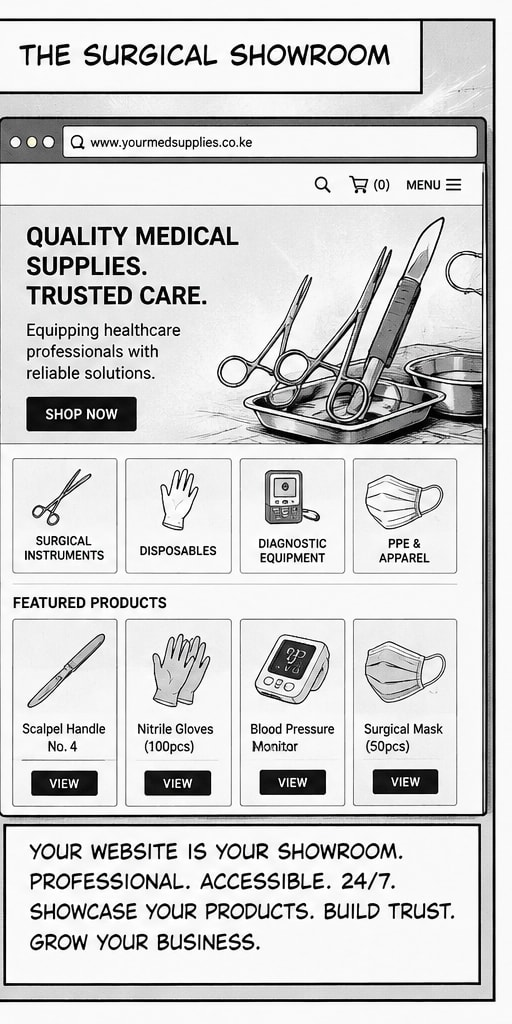
Medical equipment: your catalogue is part of the sales process
A hospital, clinic or procurement team may need to evaluate dozens of products before speaking to a supplier.
They want specifications.
They want product categories.
They want documentation.
They want to know who supplies the equipment and whether the company looks established enough to deal with.
If your entire catalogue is a collection of PDFs and WhatsApp attachments, every enquiry starts with someone on your team manually sending information.
A structured website changes that.
The buyer can browse the catalogue, understand the products and arrive at the conversation already informed.
Your sales team stops being a human search engine.
Schools: the shortlist starts before open day
Parents don't always begin with a school visit.
They search.
They compare.
They look at the curriculum, facilities, location, admissions process and the overall picture of the institution.
Then they make a shortlist.
Only after that comes the visit.
That means your website is doing something important before the admissions office ever gets the parent's call.
It is answering the first questions.
It is setting expectations.
It is giving the parent enough confidence to take the next step.
A school website should therefore feel less like an online poster and more like the front office of the institution.
The real job of a business website
A website should not exist because someone said:
"Every business needs a website."
That is lazy advice.
The real question is:
What does a potential customer need to know before they are willing to contact you?
If the answer includes your services, products, projects, location, credentials, process, pricing information or previous work, that information needs somewhere reliable to live.
A good website becomes that place.
It can be found through search.
It can be shared directly.
It can answer questions outside business hours.
And most importantly, it gives a potential customer something concrete to evaluate.
The cure
We don't start with a template and ask you what text to put into it.
We start with the buyer.
For a property company, that might mean:
- Searchable property listings
- Project and development history
- Location and verification information
- Clear enquiry paths
For a medical supplier:
- Structured product catalogues
- Technical specifications
- Product categories
- Documentation and enquiry workflows
For a school:
- Curriculum and programmes
- Facilities and school life
- Admissions information
- Fees and contact pathways
Different businesses have different evaluation processes.
The website should be built around yours.
If your customers research you before they contact you, your digital presence is already part of your sales process.
The question is whether it is helping you get evaluated — or giving the buyer a reason to move on.