
The Network That Worked Until It Didn't
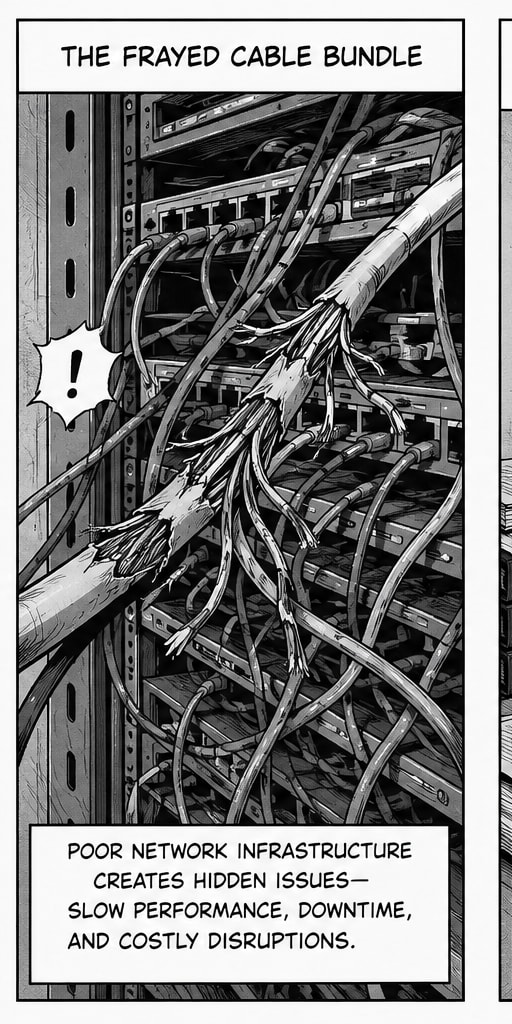
The call came during a school day.
Students were trying to access online resources. Several computers had already lost connectivity. Staff couldn't tell where the fault was, only that parts of the network kept disappearing.
The network had not failed overnight.
It had been failing slowly for years.
What we found
Walking through the campus, the first issue was visible before opening a single cabinet.
A section of the network linking school buildings had been installed using indoor Ethernet cable on an outdoor run. Years of sun exposure had hardened and damaged the cable jacket. The link was no longer reliable.
Inside the buildings, the story continued.
- No patch panels.
- No structured cable management.
- No proper trunking in several runs.
- Multiple unmanaged switches distributed across the network.
- Little visibility into where cables started or ended.
- Several computers disconnected or improperly terminated.
Nothing looked catastrophic in isolation.
Together, however, every future fault became harder to find, harder to diagnose and more disruptive to learning.
The real problem
The damaged outdoor cable was only the symptom.
The larger issue was that the network had grown without structure.
New devices had been added whenever they were needed. Additional cables had been pulled whenever someone needed another connection. Small decisions accumulated over time until nobody had a clear view of the entire network.
When something stopped working, troubleshooting became a process of elimination rather than a process of management.
Why this matters
Schools depend on connectivity far more than they did a decade ago.
Student portals, administration systems, online learning resources, examinations, printers and communication platforms all rely on the same infrastructure.
When the network becomes unreliable, teaching time is lost, administrative work slows down and students feel the impact immediately.
The work
The damaged runs were identified and replaced with proper outdoor-rated cable where required.
Existing cable routes were reorganised and properly terminated.
Network points that had lost connectivity were tested and restored.
Computers that could not access the network were traced, diagnosed and brought back online.
The goal was not to add complexity.
The goal was to restore reliability and create a network that staff could depend on every day.
The lesson
Most network failures are not caused by a single dramatic event.
They come from years of shortcuts.
The wrong cable in the wrong environment. The missing labels. The unmanaged growth. The assumption that if it works today, it will work tomorrow.
Eventually those shortcuts become the outage.
If your organisation relies on a network that nobody fully understands, the problem is rarely the latest fault.
The problem is usually the system underneath it.