
Your Business Should Not Need a Human Bridge Between Every System
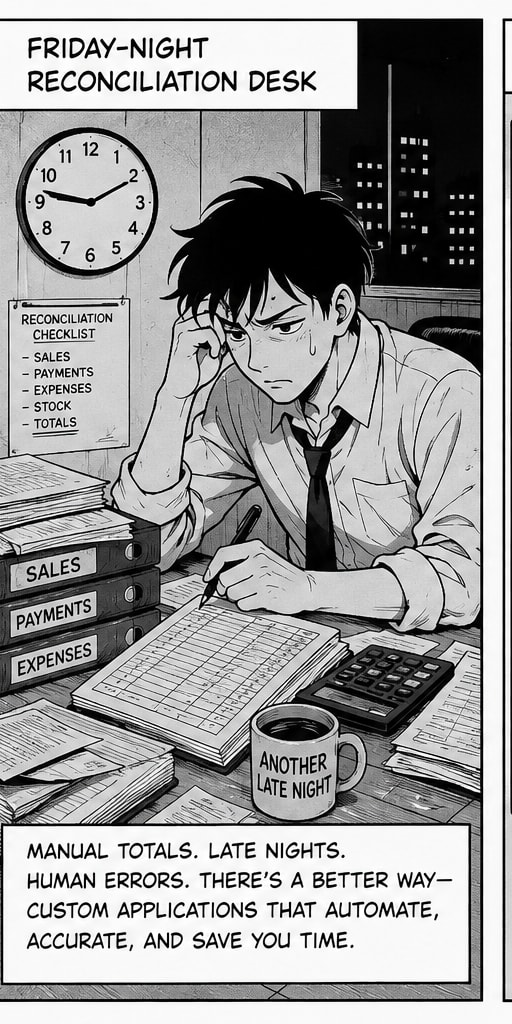
There is a strange point in the life of a growing business.
The business is busy.
Customers are coming in. Orders are moving. Staff are working.
And yet, somehow, everyone is spending their day doing things that should have stopped requiring a person years ago.
Someone copies an order from WhatsApp into Excel.
Someone checks whether the payment came in.
Someone sends a screenshot to another department.
Someone updates the spreadsheet.
Someone calls the driver.
Someone asks whether the customer was contacted.
Someone spends Friday afternoon making sure everyone did what the system should have tracked automatically.
The business is functioning.
But the workflow is being held together by people.
The WhatsApp-to-Excel pipeline
It usually starts innocently.
A customer sends an order through WhatsApp.
The sales person writes it down.
Later, someone enters it into a spreadsheet.
The warehouse receives a message.
The accounts team gets another message.
The customer asks for an update.
Someone searches through the chat.
The order is eventually delivered.
Then someone has to reconcile everything.
None of these steps is particularly complicated.
That is exactly why they become dangerous.
When a simple process happens hundreds of times, every manual handoff becomes another opportunity for something to be missed.
A number gets typed incorrectly.
A message gets buried.
A payment is not matched.
An order is duplicated.
A customer waits for an update that somebody forgot to send.
The problem isn't that your employees are careless.
The process is asking them to remember too much.
When Excel becomes the database
Spreadsheets are excellent tools.
They become a problem when the entire operation depends on them.
One spreadsheet tracks customers.
Another tracks stock.
Someone has their own version.
Another person keeps the "master" copy.
Then somebody sends the latest file through WhatsApp.
Six months later, nobody is completely sure which version is correct.
At that point, Excel is no longer just a spreadsheet.
It has become an unofficial business system.
And unofficial systems are difficult to control, audit or scale.
The employee who knows everything
Every growing business eventually has one.
The person everyone calls when something doesn't make sense.
They know where the files are.
They know which spreadsheet is current.
They know which customer paid.
They know which orders are waiting.
They know which approval is still pending.
They know the workaround.
If that person is on leave, the workflow slows down.
If they leave the company, part of the company's operational knowledge leaves with them.
That is not an employee problem.
It is a systems problem.
Knowledge that matters to the business should not exist only inside someone's memory.
Automation is not about replacing people
Good automation does not begin with:
"How many employees can we eliminate?"
It begins with:
"Why are highly capable people spending their time doing this?"
If a person has to repeatedly copy information from one place to another, that is a candidate for automation.
If someone has to manually calculate the same figure every day, that is a candidate for automation.
If a manager has to ask three people for the status of an order, that is a workflow problem.
If a customer has to wait for someone to find information that already exists in your business, the information is in the wrong place.
The goal is not fewer people.
The goal is fewer unnecessary steps.
What a proper workflow looks like
Imagine a customer places an order.
The system records it.
The relevant team is notified.
Stock is checked.
The order moves to fulfilment.
The customer receives an update.
Payment is recorded.
The delivery is logged.
The sale appears in the dashboard.
Management can see what happened without asking five people.
Nobody had to copy the same information into four different places.
That is what a business system should do.
It should carry information forward.
The cure
We build the system around the way your business actually operates.
That can mean:
- Custom dashboards that replace scattered spreadsheets.
- Order management that takes work out of WhatsApp and into a structured workflow.
- CRM systems that keep customer information and follow-ups in one place.
- Inventory systems that connect stock, sales and fulfilment.
- Approval workflows that show exactly what is waiting and who needs to act.
- Automated reports that remove repetitive reporting work.
- Notifications and reminders that happen because the system knows they need to happen.
- Integrations that move information between the tools your business already uses.
We don't automate a process simply because automation sounds impressive.
First, we map the workflow.
Then we find the bottlenecks.
Then we decide what should be removed, what should be automated and where a person actually needs to stay involved.
The result is not another piece of software your team has to fight with.
It is a system that fits the way the business already works.
Your people should be making decisions, serving customers and moving the business forward.
They should not spend their day copying information between systems, hunting through WhatsApp messages or rebuilding reports that the business has already generated.
If the same task happens every day, the same information is entered more than once, or the same person has to manually keep the operation connected, there is probably a better way to run it.
That's where we come in.